Psychological trauma
The ThicketPsychological trauma in the narrative is the lasting damage produced when violence overwhelms ordinary ways of understanding, protecting, and remembering life. It begins with deaths that cannot be prevented or properly mourned, expands through captivity and sexual exploitation, and reaches into the survivors’ bodies, loyalties, religious beliefs, and ideas of who they are. The novel repeatedly shows that survival does not restore the person who existed before the violence: the event remains active in memory, conduct, and the uneasy attempts to tell what happened.
Origins in Epidemic and Loss
The earliest wound is the smallpox epidemic at Hinge Gate. Jack Parker and Lula Parker survive because the disease passes them by, but their parents do not. Their parents had never been sick, yet the illness brings fever, blisters, and labored breathing, leaving the children to watch them die while being forbidden to touch them for fear of infection. The surrounding town is transformed into a landscape of hurried burials, bodies loaded into wagons, unidentified dead burned, and quarantine signs barring both entry and exit. This is trauma before the narrative gives it a psychological name: grief is combined with helplessness, physical separation, and the knowledge that the ordinary structures of family and community cannot protect anyone.
The Sabine River ferry disaster deepens that formative loss. Jack and Lula are carried toward the ferry by their grandfather, and the disaster separates the surviving children from him while Lula is taken away by men who cross the river. A witness can identify only fragments: three men, a girl, horses, a fat fellow and a big man sharing one horse, and a Black man with the girl on another. The witness does not know who died, while a sorrel horse hangs broken in an elm on the riverbank. The uncertainty matters as much as the violence. The survivors receive no orderly account of the disaster, no secure body to bury, and no assurance that Lula is alive or willing to go. Trauma therefore enters the plot as both catastrophe and an unanswered question, compelling Jack to organize his future around recovery.
Captivity, Sexual Violence, and the Failure of Recovery
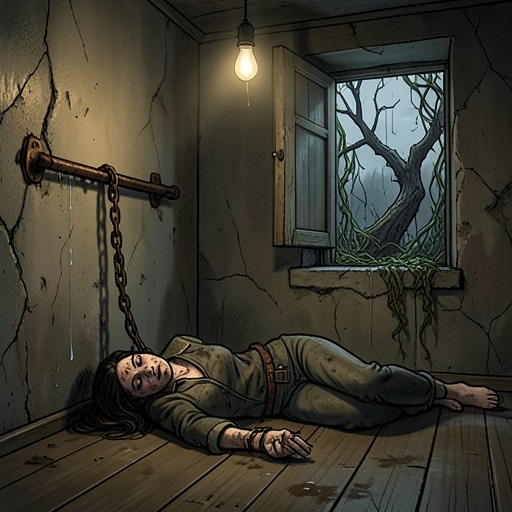
Jimmie Sue’s history gives the narrative its most explicit account of trauma’s delayed and deceptive persistence. She ran away from home because her mother wanted her to become a seamstress, and at an Austin train station Steve presented himself as someone who loved her and would take her to a better life. Instead, he brought her to a whorehouse. Its electric lights, gas burner, and indoor toilets offer a grotesque contrast to the coercion carried out inside it: modern conveniences do not make captivity less brutal. Jimmie Sue recalls that Steve had men take her and assault her as a supposed process of “breaking me in.” The violence was not chosen, and her later participation in prostitution cannot be read as evidence that the original injury disappeared.
Her present behavior combines survival strategy, anger, humor, and a guarded form of agency. When Jack Parker first encounters her, she can tease him, expose his embarrassment, and speak openly about sex, yet her candor is not proof of emotional freedom. She wants to escape Steve and says that the life he promised was a lie, but she also warns Jack Parker that she may leave again and become an “independent contractor” in her profession. Her uncertainty about staying is a realistic consequence of captivity: she has a direction to move toward, but not yet a secure home to return to. She agrees to travel with Jack Parker partly because she likes him and partly because she has nowhere else to go, making intimacy inseparable from displacement and need.
Jimmie Sue recognizes the resemblance between her own experience and Lula Parker’s captivity. While Fatty Worth is being beaten, she explains that remembering what was done to her makes her think of Jack Parker’s sister and of the way she came to be sitting with him in a whorehouse. She takes satisfaction in Fatty Worth’s suffering because men like him and the men connected with Lula Parker’s abduction represent the same structure of sexual domination that injured her. Yet the narrative refuses to turn revenge into recovery. When Jack Parker suggests that Lula Parker can get over what happened because Jimmie Sue has apparently done so, Jimmie Sue sharply asks who said she had recovered. Her correction identifies trauma as an unseen continuation rather than a completed past event: functioning, speaking, traveling, or entering a new relationship does not prove that the wound has healed.
Violence Repeated Through Witnessing and Memory
Jack Parker’s own trauma becomes visible when he is made to clean Fatty Worth after the latter has been beaten. Jack Parker initially imagines shooting Fatty Worth slowly, first in the feet, then the knees, elbows, groin, and neck, naming Lula Parker with each shot. The fantasy turns the rescue mission into an imagined punishment and shows how another person’s captivity has entered Jack Parker’s mind as a physical pressure. He cannot stop imagining what may have happened to his sister, and the thoughts produce a rising sickness in him.
Instead of killing Fatty Worth, Jack Parker cleans the blood from his face. He displaces Fatty Worth into the image of a wounded dog Jack Parker once rescued, although he admits that he liked the dog better. The comparison permits an act of care without granting Fatty Worth forgiveness; Fatty Worth becomes an injured body to be handled, not a human being toward whom Jack Parker can feel ordinary compassion. The scene holds revenge and care in the same frame. Jack Parker’s violence has not vanished, but it is temporarily redirected into preserving the life of someone he wants to punish.
Later, the killing at the trading post breaks through Jack Parker’s earlier moral defenses. He remembers shooting a bird that fell with a broken wing, an open beak, and pain and confusion in its eyes. His father ends the bird’s suffering by twisting its neck, and the family eats it. Jack Parker distinguishes that necessity from the later killing of armed men, yet the memory returns because the men’s dying resembles the bird’s suffering. He sees Katy’s mouth open and blood coming from it, and recognizes that he has crossed a dark moral divide. The fact that Katy had been protecting one of the men who stole Lula Parker does not erase Jack Parker’s distress. He tells himself that the violence was necessary, but the feeling remains deeper and sadder than the justification. His religious language changes accordingly: he feels farther from Jesus and closer to Satan, while older fears about sexual guilt seem trivial beside watching a man’s life drain away and seeing Hog eat pieces of him.
The narrative also shows trauma through the telling of violence. Shorty’s account of the Comanche raid on Sheriff Winton’s home pauses when the surrounding night becomes oppressive and Jack Parker realizes he has been holding his breath. Shorty himself releases his breath as though it were his last, and the story moves from the slaughter of livestock to the abduction of Winton’s wife and child. The child is dragged through thorn brush, impaled through the belly on a sharpened limb, and left unable to escape the wound. Shorty insists that the perpetrators are human, making the horror more rather than less intelligible: monstrosity is not safely confined to an inhuman category.
Shorty then finds Winton’s wife after she has been raped and tortured to death. Her nose and lips have been cut off, and dirt has been forced into her mouth and throat so that she cannot breathe. Winton has already reached the body but, blinded by anger, leaves it unburied while pursuing the attackers. Shorty recognizes that Winton’s fury has made him as savage and blind as the people he hunts. The episode gives trauma a collective form: the violence injures the dead, the abducted child, Winton, Shorty, and every later witness, while turning rescue itself into a vehicle for further damage.
Bodies, Identity, and Survivorship
Trauma is repeatedly represented through altered or violated bodies. The smallpox epidemic covers the dead with blisters and makes breathing sound broken; Fatty Worth’s face is cut and bloody; the murdered family found by Eustace Cox includes an elderly woman whose clothes have been removed after sexual violence; Winton’s wife is mutilated and suffocated; and the child in Shorty’s account is reduced to a body caught in thorns and wood. These scenes do not treat physical injury as a detachable spectacle. Each wound changes what survivors must remember, what they can say, and how they understand the world’s claims to order or justice.
The same connection between body and identity appears in the descriptions of Eustace Cox. Eustace identifies himself as part white, part Black, and part Comanche, and says that his mother and her people taught him to track. His mixed ancestry gives him a specialized knowledge and a place in the rescue party, but it also locates him within the racial violence of the setting. He asks to be paid, insists that Shorty accompany him, and includes Hog in the tracking party because he is accustomed to the animal’s company. Practical self-definition and inherited knowledge stand against a society that repeatedly turns racial, sexual, and bodily difference into grounds for domination.
Lula Parker’s return does not provide a simple restoration of purity. As Shorty approaches, Lula Parker tells Jack Parker that she is not as pure as she once was, and then begins to speak of the men who abused her. Jack Parker answers that he has something for her and gives her Lula Parker’s silver-star necklace. She hesitates because a different girl wore it, but Jack Parker insists that she is the same to him and places it around her neck. The object becomes an attempted bridge between remembered identity and changed identity. Lula Parker’s refusal to take it at first acknowledges that the past cannot simply be put back on; Jack Parker’s insistence expresses love, but also his wish to recover the sister he remembers. The reunion therefore contains tenderness and damage at once.
Trauma, Attachment, and the Limits of Healing
Jimmie Sue’s relationship with Jack Parker offers companionship without promising a cure. She joins him because she likes him and because she has nowhere else to go, while openly reserving the possibility of leaving. Their intimacy develops under conditions shaped by prostitution, flight, religious doubt, and the urgent search for Lula Parker. In a burned clearing, with the group planning to leave at first light, Jack Parker slips beneath Jimmie Sue’s blankets. She asks whether Jesus will be angry, and Jimmie Sue answers that Jesus can forgive if he wishes; otherwise he is not as forgiving as people claim. The exchange marks the collapse of Jack Parker’s former religious certainty, but it also gives both characters a language for desire that does not pretend their histories have vanished.
Jimmie Sue’s warning and Lula Parker’s hesitation prevent the narrative from equating attachment with repair. Jimmie Sue can choose movement, companionship, and sexual self-definition while still carrying the memory of coercion. Lula Parker can accept Jack Parker’s recognition while refusing the necklace at first and admitting that she has changed. Jack Parker can pursue rescue while discovering that revenge and killing have transformed him. Each survivor remains attached to others, but none is returned to an untouched earlier state.
Psychological trauma consequently functions as a structure of recurrence. Epidemic loss prepares the children for later separation; captivity echoes across Jimmie Sue’s and Lula Parker’s stories; witnessed mutilation returns in Jack Parker’s memory of the bird; and the retelling of Winton’s tragedy makes the listener physically experience suspense, breathlessness, and horror. The book’s deepest claim is not that suffering automatically ennobles its victims or that love erases it. Instead, survival consists of carrying damaged memory into new relations and choices, while recognizing that the person who survives is both continuous with and irreversibly altered from the person who suffered.